Let’s start with the obvious: this article is written by one of the two sides. We are the STOK Terminal team, and a 100% neutral comparison doesn’t exist — not here, and not in the affiliate reviews either. What we can offer is an honest comparison: we will openly tell you what Yahoo Finance does better than us, and which type of investor we are the wrong choice for.
The Core Difference: Generalist Portal vs Workbench
Yahoo Finance is a portal. Its job is to cover everything — stocks, ETFs, crypto, forex, news, earnings, video — for everyone, free, funded by advertising. And it is one of the best at that: it is probably the most-used financial website on the planet.
STOK Terminal is a workbench. Its job is to cover one process — analyzing a company’s fundamentals, tracking it in a watchlist and connecting it to your portfolio — deeply and without noise, for the investor who builds their own thesis.
That difference in purpose explains everything else: the ads, the data depth, the price and who each one is for.
What Yahoo Finance Does Better (No Spin)
- Universal coverage, free. Quotes for practically any asset in the world, in real time and at no cost. For “what is X trading at?” you need nothing else.
- News and earnings in one feed. It aggregates financial press, filings and the earnings calendar with a breadth no specialized tool matches.
- Maturity and ecosystem. Decades in the market, well-worn mobile apps, US broker integrations and a huge community.
- Premium with real history. The Gold tier (around $39/month) unlocks up to 40 years of exportable financial statements — more raw history than almost anyone offers.
- A free portfolio tracker that is fine for logging positions and watching their value.
If after reading this list you think “I just want free quotes and news,” the honest answer is: stay on Yahoo Finance. Pay nothing.
What STOK Terminal Does Differently
STOK Terminal is currently in early access, opened from a free list in signup order. Joining the list is free and creates no charge; we say so upfront. Early users pay €6.95/month once they activate their access — a 50% discount off the €13.90 public price — and keep that 50% discount on the future public price while their subscription remains active. If they cancel and return later, the then-current price will apply. Nothing is charged while you wait on the list, and the trial only starts when you accept your invitation.
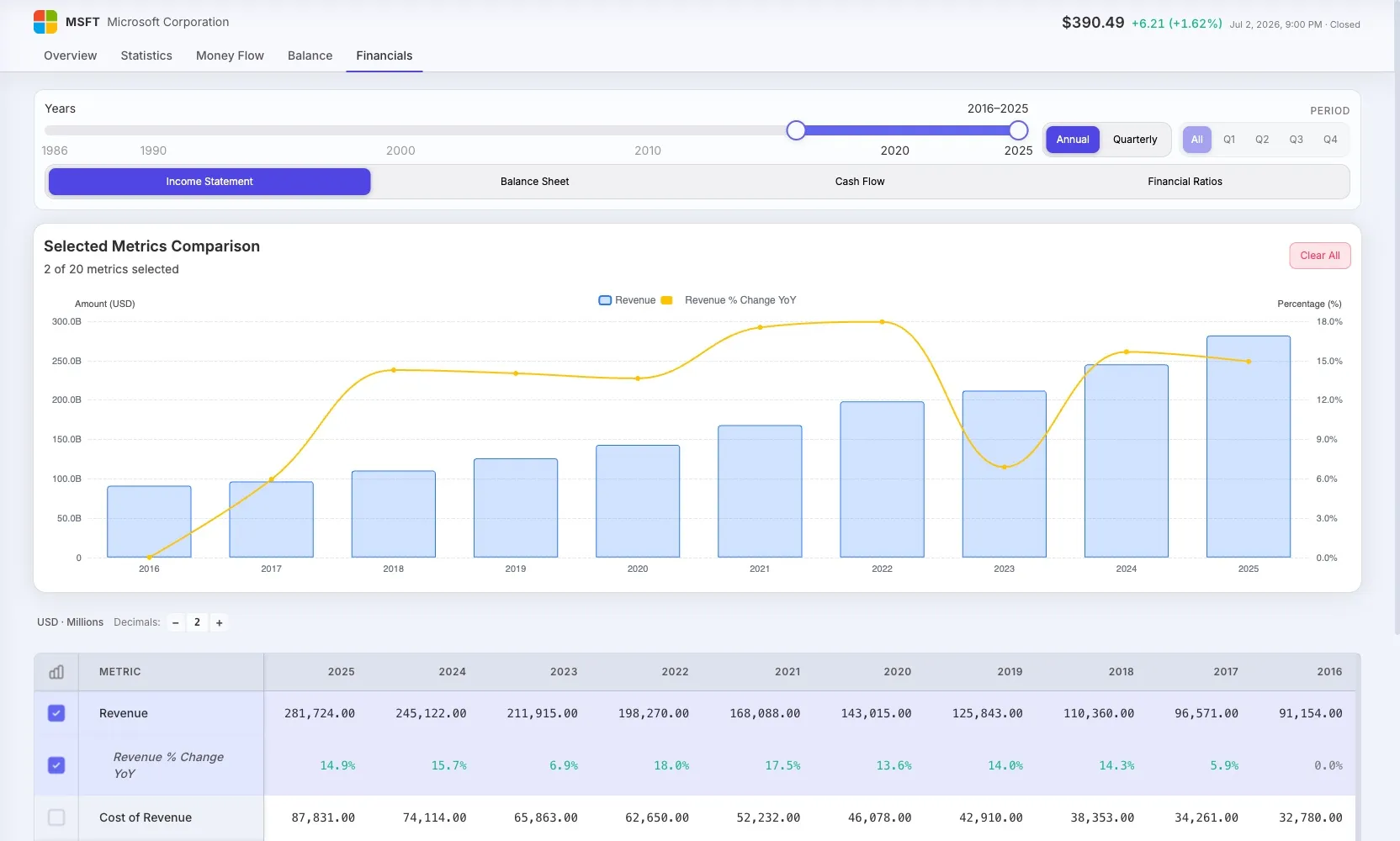
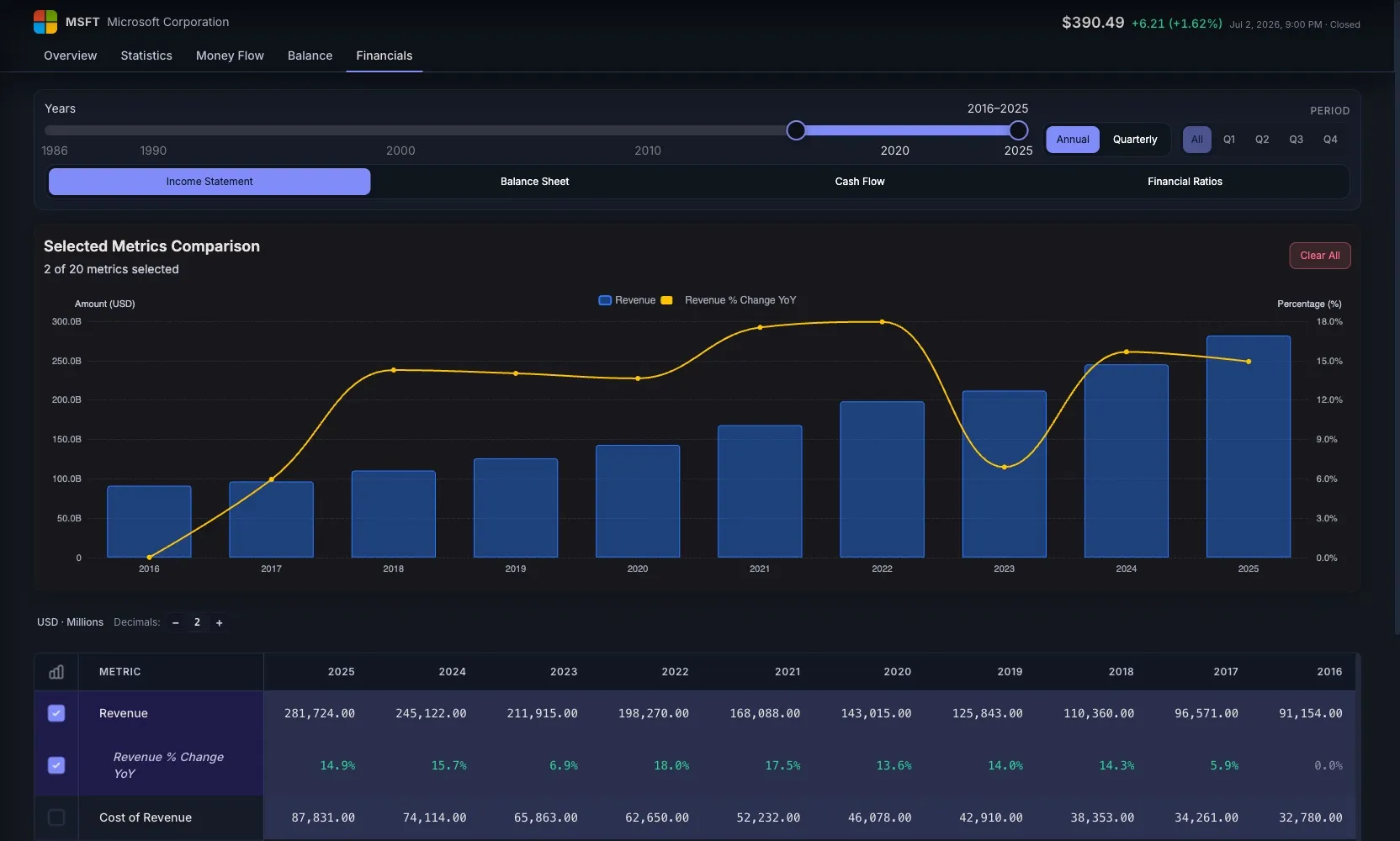
- Multi-year fundamentals as the core of the product, not a tab. Income statement, balance sheet, cash flow and ratios (ROIC, margins, free cash flow) in side-by-side comparable tables. On free Yahoo, history stops at ~5 quarters and key ratios are not pre-calculated.
- Ad-free, by design. Yahoo is free because you are the audience being sold. Our model is a subscription: the interface is built for focus, not for generating impressions.
- The full flow connected: analyze the company → track it in watchlists with quotes and news → connect it to your portfolio with a full transaction ledger. On Yahoo these steps exist but don’t talk to each other.
- Euros and Spanish. Priced in euros (€6.95/month for early users, 50% off the €13.90 public price), with a Spanish-language site and guides.
What we don’t have today, plainly: Yahoo’s breadth of news, crypto and forex coverage, native mobile apps (the web app works well on mobile), a screener (coming later) or its decades of maturity. We are in early access via waitlist, building the core flow first.
The “Free” Trap: Where Yahoo Starts Charging
The fair question isn’t “free Yahoo or paid STOK?” — it’s what happens when free runs out. The typical path:
- You start with quotes and news. Free and perfect.
- You want to analyze a company in depth. Free history stops at ~5 quarters; serious analysis needs full cycles.
- You look at the premium tiers: Bronze $9.95/month (fewer ads, more history), Silver $24.95/month, Gold $39/month (~$349/year) with the 40 years of statements and analysis tools.
In other words: the Yahoo you actually analyze with costs between $25 and $39 a month, in dollars. At that price you are no longer competing against “free” — you are competing against every specialized tool, many of them cheaper. We ran that full comparison in Yahoo Finance alternatives.
Comparison Table (July 2026)
| Yahoo Finance | STOK Terminal | |
|---|---|---|
| Philosophy | Ad-supported generalist portal | Specialized, ad-free workbench |
| Quotes and news | Excellent, free, universal | Focused watchlists and market view |
| Fundamental history | ~5 quarters free; up to 40 years on Gold | Up to 30+ years (plan-dependent) |
| Pre-calc ratios (ROIC, FCF…) | Premium-gated | Yes — the core of the product |
| Portfolio | Basic free tracker | Yes, integrated |
| Screener | Yes (basic free, more on premium) | No (coming later) |
| Ads | Yes on the free tier | No |
| Language | English (limited local versions) | Spanish + English site and guides |
| Billing | USD (Bronze $9.95 / Silver $24.95 / Gold $39/mo) | EUR (€6.95/mo for early users; €13.90 public) |
| Product status | Mature, decades in market | Early access |
When to Choose Each
Choose Yahoo Finance if:
- You only need quotes, news and a quick glance — free.
- You follow many asset classes (crypto, forex, funds) in one place.
- You value mature mobile apps and a huge news feed.
Choose STOK Terminal if:
- You analyze companies with multi-year financial statements and want the ratios pre-calculated.
- You care about the full flow: analysis → watchlist → portfolio in one place, ad-free.
- You prefer paying in euros and working with Spanish-language guides.
- You accept an early-access product in exchange for the launch price.
Use both if: you want Yahoo as a fast market source and a workbench for deep analysis. It is the most common setup among our early users.
Frequently Asked Questions
What is the main difference between STOK Terminal and Yahoo Finance? Scope. Yahoo Finance is a generalist portal: quotes, news and basic data for almost any asset, free and ad-supported. STOK Terminal is a specialized workbench: multi-year fundamentals, watchlists and portfolio connected in one flow, ad-free, in euros.
Isn’t Yahoo Finance free? Why pay for anything else? For quotes, news and a quick glance, free Yahoo is fine and you should pay nothing. The question appears when you analyze companies seriously: free history is shallow (~5 quarters) and ratios like ROIC are not pre-calculated. There you choose between its premium (from $9.95/month) and specialized tools.
Which is cheaper, STOK Terminal or Yahoo Finance premium? Yahoo’s tier with deep fundamentals is Gold, around $39/month (~$349/year). STOK Terminal is €6.95/month at the launch price on activating access (€13.90/month public price), in euros. Verify current prices on both sites — they change with promotions.
Can I use both? Yes, and it is the most common setup: Yahoo Finance as a fast source of quotes and general news, and a specialized tool for fundamental analysis and serious portfolio tracking. They do not compete at the same step of the process.
Portal or Workbench?
If it’s the latter, we are building STOK Terminal for you: multi-year fundamentals, watchlists and portfolio in one flow, in euros with Spanish-language guides.
Join STOK Terminal free — 14 days free when you activate your access and a 50% discount for as long as your subscription stays active.
Transparency
Comparison written by the STOK Terminal team — keep that in mind as you read. Yahoo Finance prices (Bronze $9.95 / Silver $24.95 / Gold $39 per month) were verified against official sources in May 2026; they may vary with promotions or by region, and we don’t know how they will evolve. Confirm current numbers on finance.yahoo.com before subscribing. This article is informational and not financial advice.